

What is the standard weight per square meter of Gr 4 Titanium Sheet?
Dec 02, 2025
Leave a message
Hey there! As a supplier of Gr 4 Titanium Sheet, I often get asked about the standard weight per square meter of this material. So, I thought I'd take some time to break it down for you in this blog post.
First off, let's talk a bit about Gr 4 Titanium Sheet. It's a high - strength, corrosion - resistant titanium alloy that's widely used in various industries, like aerospace, marine, and chemical processing. Its excellent mechanical properties make it a top choice for applications where durability and performance are key.
Now, getting to the main question: what's the standard weight per square meter? Well, the weight of a Gr 4 Titanium Sheet per square meter depends on its thickness. Titanium has a density of approximately 4.51 g/cm³. To calculate the weight per square meter, we use the following formula:
Weight (kg/m²)=Density (g/cm³)×Thickness (mm)
Let's say we have a Gr 4 Titanium Sheet with a thickness of 1 mm. First, we convert the density from g/cm³ to kg/m³. Since 1 g/cm³ = 1000 kg/m³, the density of titanium (4.51 g/cm³) is 4510 kg/m³.
Using the formula, for a 1 - mm thick sheet:
Weight = 4510 kg/m³×0.001 m = 4.51 kg/m²
If the thickness is 2 mm, then the weight per square meter would be:
Weight = 4510 kg/m³×0.002 m = 9.02 kg/m²
As you can see, the weight per square meter increases linearly with the thickness of the sheet.
It's important to note that these are theoretical values. In real - world scenarios, there might be some slight variations due to factors like manufacturing processes and the presence of impurities. But generally, these calculations give you a pretty good ballpark figure.
When it comes to comparing Gr 4 Titanium Sheet with other titanium products, it's worth mentioning Gr 5 Titanium Sheet. Gr 5 is another popular titanium alloy, known as Ti - 6Al - 4V. It has different mechanical properties compared to Gr 4. Gr 5 is stronger and more ductile in some cases, but it also has a different density and weight per square meter depending on its thickness.

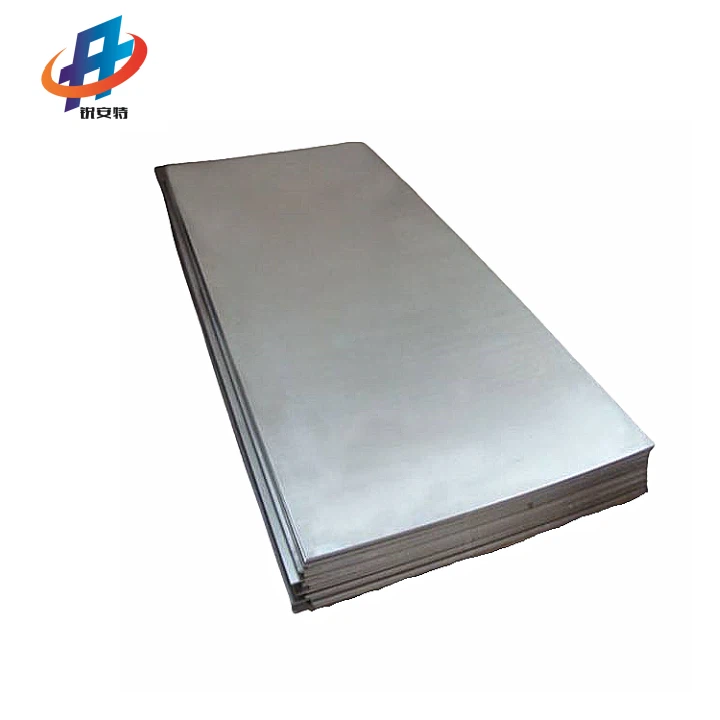
Then there are BT20 Titanium Plate and BT9 Titanium Plate. These are Russian - made titanium alloys. BT20 is a high - strength alloy, and BT9 has good heat - resistance properties. Their weights per square meter also vary based on their specific compositions and thicknesses.
As a supplier, I've seen how different industries have unique requirements for Gr 4 Titanium Sheet. For example, in the aerospace industry, weight is a critical factor. Engineers often look for the optimal thickness that provides the necessary strength while keeping the weight down. On the other hand, in the chemical processing industry, corrosion resistance is the top priority, and they might be more willing to use thicker sheets for added durability.
If you're in the market for Gr 4 Titanium Sheet, it's essential to have a clear understanding of your requirements. Consider factors like the application, the environment it will be used in, and the mechanical properties you need. Once you've determined the thickness you need, you can easily calculate the weight per square meter and estimate the total weight for your project.
We offer a wide range of Gr 4 Titanium Sheets in different thicknesses and sizes. Our sheets are of high quality, and we ensure strict quality control during the manufacturing process. Whether you need a small quantity for a prototype or a large order for a full - scale project, we've got you covered.
If you're interested in purchasing Gr 4 Titanium Sheet or have any questions about the weight per square meter or other technical details, don't hesitate to reach out. We're here to help you make the right choice for your project.
In conclusion, the standard weight per square meter of Gr 4 Titanium Sheet is directly related to its thickness. By using the density of titanium and a simple formula, you can calculate the weight for any given thickness. And if you're looking for a reliable supplier, we're just a message away.
References
- "Titanium: A Technical Guide" by John R. Davis
- Industry reports on titanium alloys and their applications
Send Inquiry