


Gr 1 Titanium Round Bar
Why Choose Us
Product Application Scope
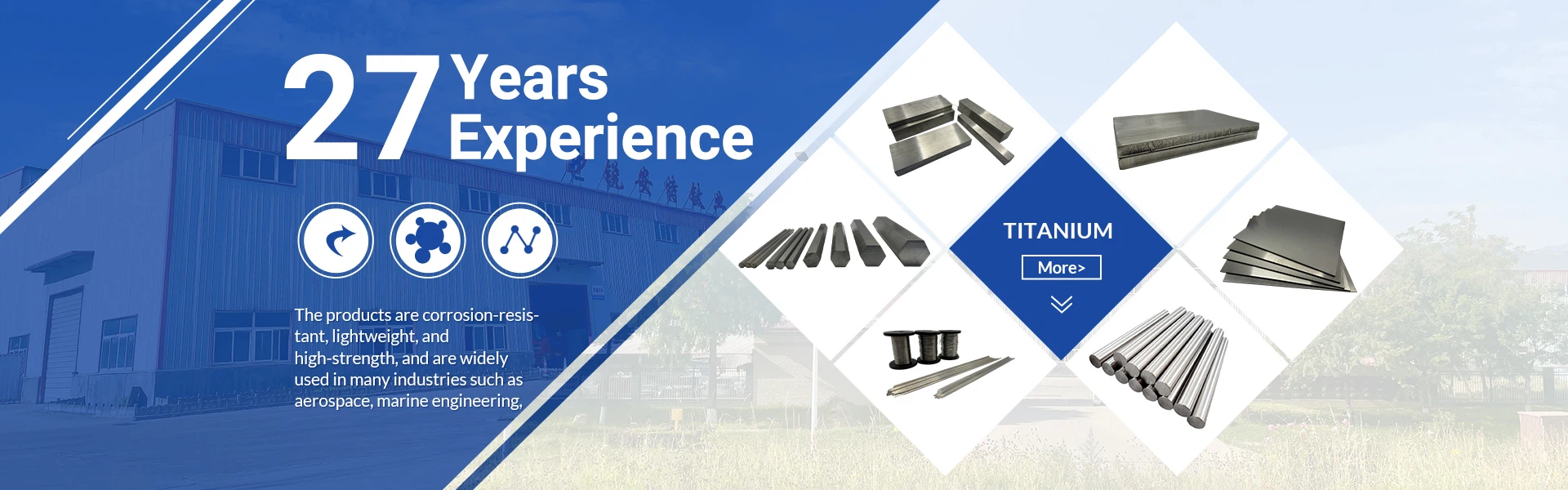
Company are renowned for their corrosion resistance, lightweight, and high strength. They are widely used across numerous industries, including aerospace, marine engineering, chemical industry, automotive industry, medical industry, electronic products, and sports equipment.
Factory Introduction
Located in Baoji City, famously known as "China's Titanium Valley," the company's premises cover an area of 20,366.46㎡, including a factory area of 10,812㎡. The total investment is approximately 86 million yuan, the company boasts five production workshops equipped with advanced production equipment and technology.
Quality First
Company always adhere to the strict quality management system inspection from raw material procurement to every link to ensure that every link of the product meets the highest standards.
Quick Delivery
Company adopt advanced process-based production methods to ensure the efficiency and stability of the production process, thereby ensuring that every order can be delivered on time.

Our Grade 2 Titanium Flat Bar is a commercially pure titanium product known for its excellent corrosion resistance, moderate strength, and high ductility. This titanium grade is ideal for applications that require a balance between strength and formability.

Our Gr5 titanium round bar, also known as Ti-6Al-4V, is one of the most commonly used titanium alloys due to its high strength, lightweight, and excellent corrosion resistance.

Our Gr 5 Titanium Hexagonal Bar, also known as Ti-6Al-4V, is a high-strength, lightweight titanium alloy widely recognized for its exceptional mechanical properties and corrosion resistance.

Our ASTM F136 Titanium Round Bar is a high-quality titanium alloy known for its excellent biocompatibility, high strength, and superior corrosion resistance.

Our Gr 23 titanium round bar, also known as Ti-6Al-4V ELI (Extra Low Interstitial), offers unparalleled biocompatibility, high strength, and superior corrosion resistance.

Our Gr 4 Titanium Hexagonal Bar is a high-performance titanium product known for its superior strength, excellent corrosion resistance, and reliability in demanding applications.

Our Gr 3 Titanium Hexagonal Bar is a high-quality titanium product renowned for its excellent strength, corrosion resistance, and weldability.

Our Gr 2 Titanium Hexagonal Bar is a commercially pure titanium product known for its excellent corrosion resistance, strength, and durability.

Our Grade 1 Titanium Hexagonal Bar is a high-purity titanium product known for its excellent corrosion resistance, lightweight properties, and good weldability.
What Is Gr 1 Titanium Round Bar?
Titanium Grade 1 is the softest and most ductile of the commercially pure titanium grades. The material is therefore primarily chosen for use in applications that have excellent corrosion resistance in a low-temperature environment with no stringent need for high mechanical strength.
Key Properties of Gr 1 Titanium Round Bar
Corrosion Resistance: It has the highest resistance to corrosion amongst all commercially pure titanium grades, particularly in chloride-rich mediums like seawater.
Ductility: It is very much malleable, thus used in various applications, where formability and weldability are concerned.
Low Strength: As compared to all the other grades, it has the lowest mechanical strength, hence not quite favorable for more stressful applications.
Biocompatibility: Due to very high purity content, this is a great material in medical, especially dental, for implants and prosthetics.
Main Differences Between Gr 1 Titanium Round Bar Vs. Titanium Grade 2 Round Bars
Mechanical Strength
Titanium Grade 1 Round Bar: In this grade, the strength is lowest among the commercially pure titanium grades and, therefore, provides applications that require more crucial formability and corrosion resistance than necessary mechanical strength.
Titanium Grade 2 Round Bar: The grade attains higher tensile and yield strength as it can easily fulfil more demanding applications that allow moderate strength with excellent corrosion resistance.
Corrosion Resistance
Titanium Grade 1 Round Bar: It is the most corrosion-resistant. A key benefit is in aggressive mediums like saltwater or chlorine-rich environments.
Titanium Grade 2 Round Bar: It is the same in corrosion resistance as Grade 1 but less effective in extremely corrosive medium.
Ductility and Formability: Titanium Grade 1 Round Bar being more ductile, it can easily get shaped or formed to complex shapes and undergo cold-forming processes.
Titanium Grade 2 Round Bar: Less ductile than Grade 1, but can still be formed into excellent shapes and can be used in welding and fabricating to parts with increased strength.
The Advantages of Gr 1 Titanium Round Bar in Industrial Applications
High Strength and Durability: One of the most significant advantages of Gr 1 Titanium Round Bar is their high strength and durability. These bars have a high strength-to-weight ratio, which means they can withstand high loads without being too heavy. Titanium has a tensile strength of up to 180 ksi and a yield strength of up to 150 ksi. These properties make titanium round bars ideal for applications where strength and durability are critical, such as in the aerospace, automotive, and marine industries.
Excellent Corrosion Resistance: Another advantage of Gr 1 Titanium Round Bar is their excellent corrosion resistance. Titanium has a natural oxide layer that protects it from corrosion caused by exposure to air, water, and chemicals. This oxide layer also makes titanium biocompatible, making it suitable for use in medical implants and devices. Titanium round bars are used in chemical processing plants, desalination plants, and seawater applications due to their corrosion resistance.
Lightweight: Gr 1 Titanium Round Bar are lightweight, making them ideal for applications where weight is a concern. For example, in the aerospace industry, every ounce counts, and titanium's lightweight nature makes it an ideal material for aircraft and spacecraft components. Gr 1 Titanium Round Bar are also used in sports equipment such as golf clubs and bicycles due to their lightweight nature.
High-Temperature Resistance: Gr 1 Titanium Round Bar can withstand high temperatures without losing their strength and durability. Titanium has a melting point of 3,034°F, making it suitable for applications that require high-temperature resistance. Titanium round bars are used in gas turbine engines, heat exchangers, and other high-temperature applications.
Versatility: Gr 1 Titanium Round Bar are available in different sizes, grades, and alloys, making them versatile for various uses. The different titanium alloys have different properties, making them suitable for different applications. For example, Grade 5 titanium is used in the aerospace industry due to its high strength and corrosion resistance, while Grade 2 titanium is used in the medical industry due to its biocompatibility. Gr 1 Titanium Round Bar are also available in various sizes, making them suitable for different applications.
Manufacturing Process Of Gr 1 Titanium Round Bar

Gr 1 Titanium Round Bar are critical in various industries, including aerospace, medical, automotive, and chemical processing. Known for their exceptional strength-to-weight ratio, corrosion resistance, and biocompatibility, they are essential for high-performance and reliability applications.
Raw Material Selection
The journey of a Gr 1 Titanium Round Bar begins with carefully selecting raw materials. Titanium is sourced primarily from rutile and ilmenite ores. These ores undergo a series of processes to extract pure titanium. The most common method is the Kroll process, which involves converting titanium ores into titanium tetrachloride (TiCl4) and then reducing it with magnesium to produce a titanium sponge.
Melting and Alloying
Once the titanium sponge is obtained, it is melted to create a uniform alloy. This is typically done using vacuum arc remelting (VAR) or electron beam melting (EBM). Both methods ensure the removal of impurities and the creation of a homogenous titanium alloy. The choice of alloying elements, such as aluminium, vanadium, or molybdenum, depends on the specific requirements of the end product. These elements enhance properties like strength, flexibility, and corrosion resistance.
Forming the Ingots
After melting, the liquid titanium alloy is poured into moulds to form ingots. These nuggets are large, solid blocks that are the starting material for further processing. The nuggets are allowed to cool and solidify under controlled conditions to prevent the formation of internal defects. Once cooled, the ingots undergo ultrasonic testing to ensure they are free from cracks and inclusions.
Primary Forging
The next step in the manufacturing process is primary forging. The titanium ingots are heated to a specific temperature to become malleable. They are then subjected to hammering and pressing operations to reduce their cross-sectional area and shape them into billets or blooms. This process refines the internal grain structure of the titanium and improves its mechanical properties.
Rolling
Following primary forging, the billets or blooms are further processed through rolling. Rolling involves passing the metal through a series of rollers to achieve the desired diameter and surface finish. This step can be carried out at high temperatures (hot rolling) or room temperature (cold rolling), depending on the required mechanical properties and tolerances. Cold rolling, in particular, enhances the strength and surface finish of the titanium round bars.
Heat Treatment
Heat treatment is a crucial phase in the production of Gr 1 Titanium Round Bar. The bars are subjected to precise heating and cooling cycles to enhance their mechanical properties. Common heat treatment processes include annealing, solution treatment, and ageing. Annealing, for example, relieves internal stresses and enhances flexibility, while ageing increases the bars' strength and hardness.
Surface Finishing and Inspection
The final steps in the manufacturing process involve surface finishing and quality inspection. The Gr 1 Titanium Round Bar undergo surface treatments such as pickling, polishing, or sandblasting to achieve the desired surface finish and remove any oxidation or scale. After surface finishing, the bars are meticulously inspected for dimensional accuracy, surface defects, and mechanical properties. Non-destructive testing methods like ultrasonic testing and X-ray inspection are commonly employed to ensure the highest quality standards.
Titanium grade 1 is considered commercially pure and microstructurally, it is an alpha-phase alloy. The difference between the four grades lies in the amount of interstitial elements added to each grade. Titanium grade 1 contains the least interstitial elements and has the lowest ultimate tensile stress. Tensile stress is the resistance of an object to a force that could tear it apart. Grade 1 is the easiest grade of titanium to tear apart of the four grades. Many chemical processes use grade 1 titanium whereas other metals like stainless steel would not hold up to the corrosive fluids or temperature.
Grade 1 titanium is not suited in high-temperature ranges, above 400 degrees celsius, where it begins to lose its strength. Because of all these qualities, Grade 1 titanium is the material of choice for any application where ease of formability is required and is commonly available as titanium plates and titanium tubing. This unalloyed titanium has excellent corrosion resistance properties, excellent weldability and is used in a wide variety of applications. Grade 1 titanium is mainly used in marine and chemical industries where the parts are subjected to very harsh environments. This material is also used for fabricating anodes for cathodic protection applications.
It comes in many forms, with the most common being coil and wire. Either of these forms could be strips, foil, or ribbon as well as round, flat, or square. The cold formability of grade 1 titanium allows for manufacturing into various shapes like tubes and pipes.
Our Factory
Since its inception, the company has concentrated on the development, production, processing, and sales of non-ferrous metals, with a particular emphasis on titanium and titanium alloy materials. Initially, it primarily provided processing services for major companies such as Baoji Titanium Industry Co., Ltd., State Nuclear Baoji Zirconium Industry Co., Ltd., Western Materials, and the Northwest Research Institute.


FAQ
Hot Tags: gr 1 titanium round bar, China gr 1 titanium round bar manufacturers, suppliers, factory, Gr 5 Titanium Round Bar, Gr 12 Titanium Round Bar, Gr 2 Titanium Flat Bar, BT20 Titanium Plate, Gr 2 Titanium Square Bar, BT20 Titanium Alloy Round Bar
You Might Also Like


Send Inquiry